
Why We Still Need The Circus
When I wrote recently about fear and failure, I found myself circling around something deeper that I didn’t name at the time. That piece was about the private landscape inside a performer’s mind. It spoke about the tightening in the chest, the moment before stepping into the light, the split-second choice to trust your own body. But running beneath all of that is a larger question: why does any of this matter to anyone watching? Why, in a world overflowing with digital distraction, do we still gather to witness people balancing, spinning, tumbling, flying?
It’s tempting to say it’s nostalgia, or tradition, or that old familiar pull of spectacle. But that misses the heart of it. Circus isn’t just entertainment. It is one of the last communal rituals we have left that asks us to put the phone away, sit with strangers, and surrender to something unrepeatable. I try to incorporate this sense of uniqueness into every one of my performances.
During each of my shows I include a routine where I ask an volunteer to walk through the audience and collect three items. These three items (whatever they are), I will try to juggle them. Without me giving any further instruction, the crowd begins searching for their keys, their shoes, their water bottles, whatever they think would be difficult for me. It is during this routine that I find the most joy in just standing quietly and watching the audience. Instantly, they are all collaborating and working together. They are complete strangers and yet, without any other provocation, suddenly become completely invested in each other and in the moment. Everyone is on the same side, working together to find the three hardest things for me to juggle. It’s incredible. And the beautiful part is that most of the time I am able to do it, and the audience cheers. But what’s even better is when I’m not able to do it and the audience still cheers, because they figured out a way to stump me. Everyone wins! There is connection, there is collaboration, there is creativity, but there isn’t a single phone screen in sight (unless one of them is brave enough to have me juggle theirs ;P).
Screens offer us infinite perfected moments. Every clip is polished, edited, compressed into something that looks effortless. If you stumble, you delete. If the light isn’t right, you adjust. You can control every pixel. But live performance refuses that control. A trick might falter. A prop might misbehave. Someone in the audience might sneeze at the worst possible time. What makes circus (And live theater in general) beautiful isn’t the absence of uncertainty, but the way performers navigate it.
And the audience knows this, even if they can’t articulate it. They know you are doing something that can go wrong. They know your balance is real, your breath is real, your risk is real. And that creates a kind of shared electricity that digital media can approximate but never replicate. There is a reason the collective gasp of a room full of people hits differently than that nose-exhale-laugh thing we all do when we see a funny meme during a doom scroll session. Its because we are in the action. We’re a part of the moment rather than a passive bystander.
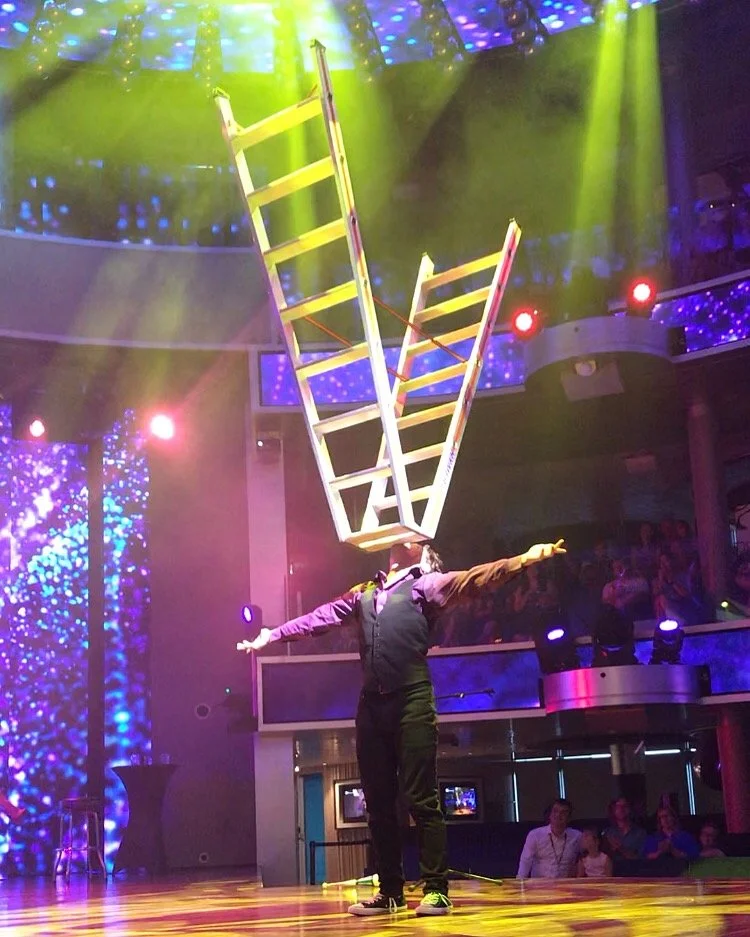
In every show I am constantly making small changes, adapting lines, and altering movements in response to the crowd. If I hear a gasp, I’ll hold a moment longer. If I get applause, I’ll acknowledge it before moving on. If I sense the crowd losing focus, I’ll move on to the next bit. Circus is a constant communication between the performers and the audience. The audience can’t help but play an incredibly important role. And both sides share the same understanding that anything can happen.
Circus is a stubborn reminder that human beings can still surprise one another. That even in a world engineered for convenience, there are still places where the outcome is uncertain. Wonder requires uncertainty. Awe requires vulnerability. And both demand presence.
The acrobat climbing the rope isn’t just showing strength. They’re showing devotion, repetition, the invisible hours behind what seems effortless. The juggler isn’t just keeping objects in the air. They are keeping the audience in a state of suspended breath, teaching them something about rhythm, control, and surrender at once. The clown isn’t just being silly. They model permission, the freedom to fail publicly, recover, and still be worthy of attention.
In the digital age, most of what we see has been smoothed at the edges. Circus resists smoothing. It insists on the texture of the real: the grit of the mat, the humidity in the tent, the rope burn on the palms, the way time bends when someone hangs in the air longer than seems possible. It is an art form built on the premise that the body is enough.
But circus also gives us something we rarely talk about: permission to feel. Permission to gasp, to laugh too loudly, to root for someone without irony, to be visibly moved without explanation. The performer offers the risk, and the audience offers the response. It is a quiet exchange of trust. Both sides participate in keeping the moment alive.
And perhaps that is why we need circus now more than ever. Not to indulge nostalgia, and not simply because it is beautiful, but because it is real in a way that is increasingly rare. It connects us through our senses, our breath, our shared fascination with what a human body can do. It shakes us awake.
I can’t tell you how inspiring it is to see a child’s (Or adults) face light up when they see one of my shows. You can see how much they care and how invested they are. Not just to me, but to the story i’m sharing. It is a connection that I don’t experience anywhere else.
In the end, circus survives because humans are wired for wonder. Not the kind you scroll past. The kind you feel in your ribs. The kind that reminds you, for a fleeting second, that you’re part of the same fragile, improbable species as the person onstage. The kind that reminds you that the world is full of uncertainty, yes, but also full of grace.
Circus is not an escape from reality. It is an encounter with it. A reminder of our limits and our possibilities, our fear and our courage, our solitude and our togetherness. It takes everything we try to flatten or hide in the digital world and lifts it into the light.
And so we keep gathering. Keep watching. Keep holding our breath. Because something in us still wants to be astonished. Something in us still needs to sit in a room full of strangers and feel that collective rise of wonder, knowing that what we are witnessing will never happen in exactly the same way again.
That, in itself, is enough.